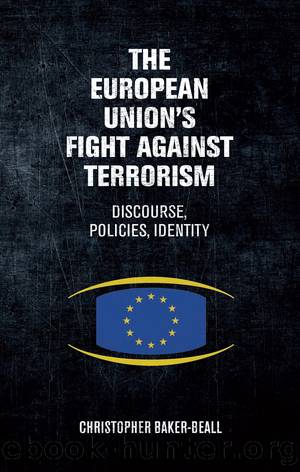
The European Union's Fight Against Terrorism: Discourse, Policies, Identity by Christopher Baker-Beall
Author:Christopher Baker-Beall [Baker-Beall, Christopher]
Language: eng
Format: epub
Tags: International Relations, Political Science, Terrorism, General
ISBN: 9781526100825
Google: CW25DwAAQBAJ
Amazon: B01HS3YDHM
Goodreads: 43601720
Publisher: Manchester University Press
Published: 2016-07-01T00:00:00+00:00
Conclusion
The aim of this chapter has been to demonstrate how the EUâs âfight against terrorismâ discourse contributes to a particular conceptualisation of terrorism, which helps to both shape and make possible the EUâs counter-terrorism response. It has been argued that this is achieved through four interlinked discourse strands that, when taken together, construct the âterroristâ other, against which the identity of the EU is produced and reproduced. Although each strand of the discourse has evolved with varying degrees of complexity, they have also remained consistent across the period analysed and can therefore be understood as continuities within the âfight against terrorismâ discourse. These four strands of the discourse construct terrorism: first, as a threat to the âvaluesâ of the European Union; second, as a ânewâ and âevolvingâ threat; third, as a form of crime or a criminal act; and fourth, as an act committed primarily by non-state actors, wherein the state is the primary victim and never the perpetrator. It has been argued that these strands tie into other aspects of the discourse including the fear that terrorists are seeking to acquire and/or use WMDs or CBRN material, as well as the perceived threat from âlone actorâ terrorism or, since the emergence of Islamic State in Iraq and Syria in 2014, the threat from âreturning foreign fightersâ. As I noted earlier in the chapter, these discourse strands help to construct the image of the âterroristâ other, a radical threat to the EU who is potentially a âcriminalâ with links to âorganised crimeâ, a ânewâ and âevolvingâ type of threat that is predominantly âreligiousâ in nature, a non-state actor, a member of a group or an individual, such as a âlone actorâ or a âreturning foreign fighterâ, who seeks to inflict âmassive casualtiesâ against the EU and its member states. This is a particularly powerful image that structures EU policy around the future-oriented fear of potential terrorist attacks and imagined scenarios of potentially devastating terrorist events. It is a representation of threat that the EU has invoked at regular instances, throughout the period analysed, to justify the development of its role not just as an actor in counter-terrorism but also to legitimise its ever-increasing role as a security actor in various aspects of internal and external security.
The chapter argued that the âfight against terrorismâ discourse has played a key role in structuring the EU approach as a criminal justice-based approach to counter-terrorism, which has differentiated it from the war-based approach of the US. Throughout the formulation of its counter-terrorism response the EU has articulated the need to develop policies that are consistent with EU values, such as the protection of human rights and civil liberties, reflecting the EUâs own self-perception as a âcivilianâ or ânormativeâ power. It has been argued that this conceptualisation of EU identity, which is normally used to explain the external projection of EU identity, can also be used to explore and understand the internal projection of EU identity and to recognise various âothersâ against which EU identity is produced and reproduced.
Download
This site does not store any files on its server. We only index and link to content provided by other sites. Please contact the content providers to delete copyright contents if any and email us, we'll remove relevant links or contents immediately.
| Anthropology | Archaeology |
| Philosophy | Politics & Government |
| Social Sciences | Sociology |
| Women's Studies |
The Secret History by Donna Tartt(19086)
The Social Justice Warrior Handbook by Lisa De Pasquale(12190)
Thirteen Reasons Why by Jay Asher(8909)
This Is How You Lose Her by Junot Diaz(6886)
Weapons of Math Destruction by Cathy O'Neil(6279)
Zero to One by Peter Thiel(5801)
Beartown by Fredrik Backman(5754)
The Myth of the Strong Leader by Archie Brown(5507)
The Fire Next Time by James Baldwin(5442)
How Democracies Die by Steven Levitsky & Daniel Ziblatt(5218)
Promise Me, Dad by Joe Biden(5153)
Stone's Rules by Roger Stone(5087)
A Higher Loyalty: Truth, Lies, and Leadership by James Comey(4960)
100 Deadly Skills by Clint Emerson(4925)
Rise and Kill First by Ronen Bergman(4788)
Secrecy World by Jake Bernstein(4752)
The David Icke Guide to the Global Conspiracy (and how to end it) by David Icke(4717)
The Farm by Tom Rob Smith(4507)
The Doomsday Machine by Daniel Ellsberg(4490)
